My Popular Posts
-
 For the publisher of my magazine I would like to use IPC Media as according to the media and internet resources they are the leading consum...
 -
Through weeks of work in the class room and out of school looking at popular magazines and my results I have received back from my Question...

Showing posts with label Preparation. Show all posts
Showing posts with label Preparation. Show all posts
Friday, 10 January 2014

Wednesday, 8 January 2014
Tuesday, 7 January 2014





Monday, 6 January 2014

Sunday, 1 December 2013
Edited Photos
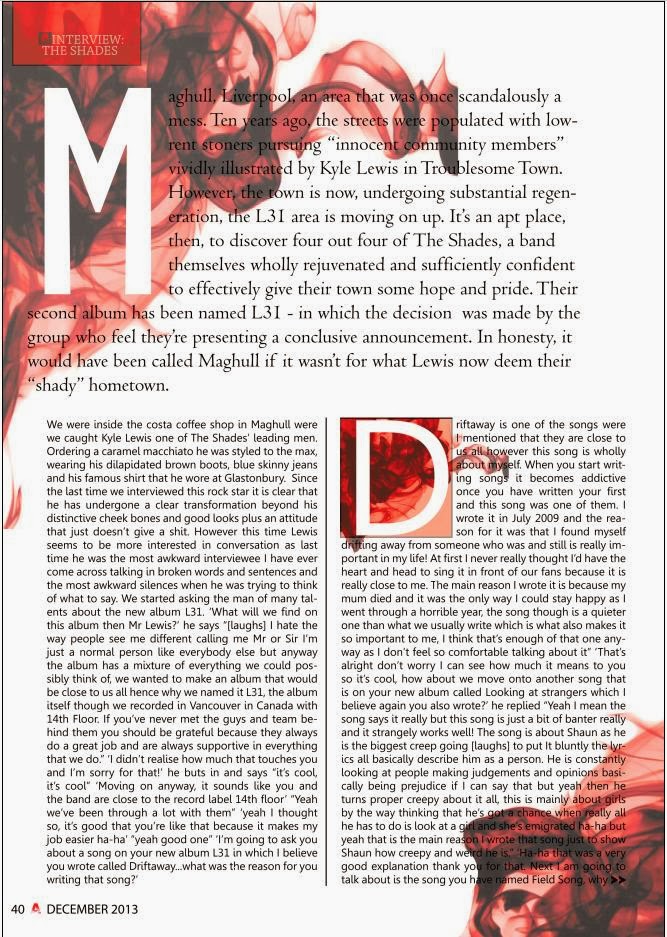
Before including my photos in my magazines I wanted to give them that little bit more edge than a normal shot.
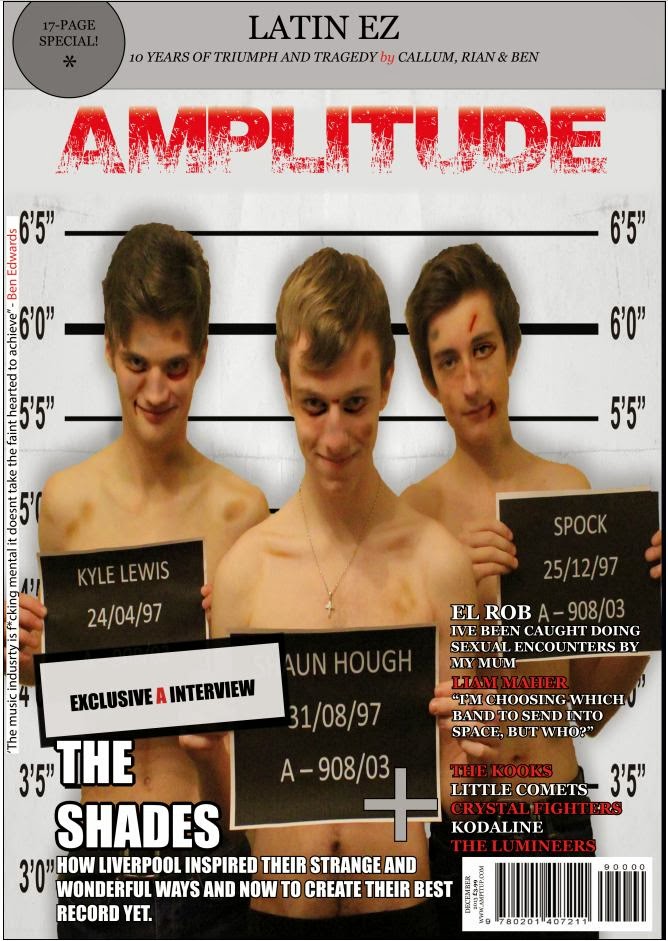
My first photo is of my band The Shades however I just took a picture of the three other guys. I was trying to react a photo that Biffy Clyro had already had taken which I had in my research.

Before taking my photo I had to set Kyle, Shaun and Spock up in the order that I wanted and gave them a mug shot board for them to hold as you can see below.

Once I took the photo I could move onto the editing, this was the most enjoyable part because I could experiment a bit with different tools. The first thing I did was I used the Lasso tool to cut round them so I had no background. Then I could work on the bruises and making parts seem bolder to do this I used the burn tool which allowed me to make out that they have bruises. My next challenge after the burn tool was to add colour to their skin and features which I simply used the adjustments moving up sliders until I got the effect I wanted. Then once all that was done I could move onto the background where I made a new layer and sent the mug shot wall to the back then the last thing I did was added a drop shadow to make it look more realistic.

Friday, 15 November 2013
Photo Shoot 2


The next photoshoot I took was to get a photo for my contents page and was firstly unintentional but then I realised that it could be an affective photo to use so I took many photos until I decided with the photo below which I used on my contents page.
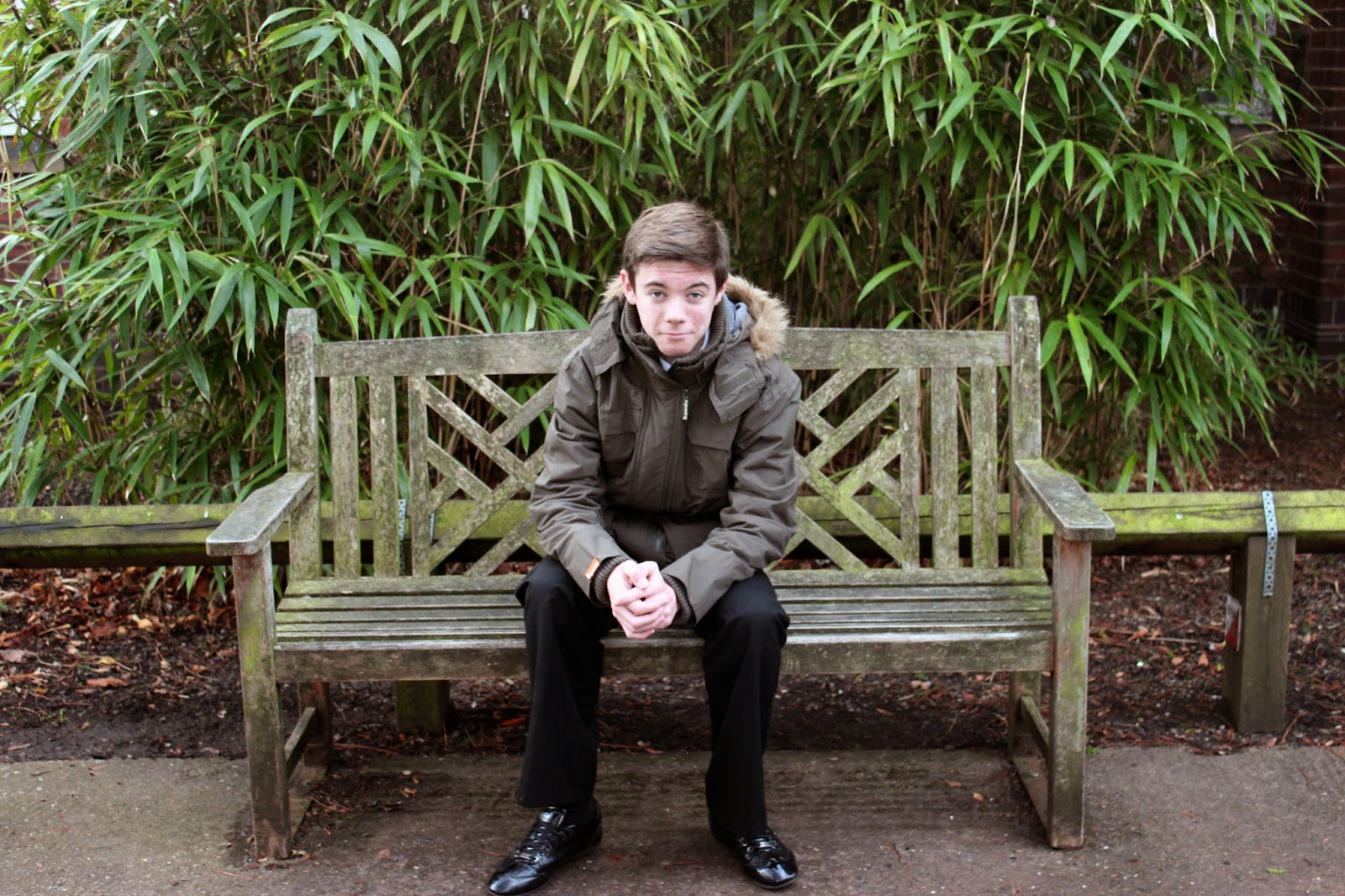
Photo Shoot 1


These photo's are the photo's I took for my front cover page and was the first photo shoot I took, in order to get the best shot possible, the photos above go in order of how I took them and as you can see they are progressing between each one until I got the final photo which is the photo you see below.

Photo Shoot 3


For my last photo shoot I only took two photos, the right photo you see I took with a filter on my camera to give the vintage effect and the other one I took with selected lighting as I wanted to reduce the chance of shadows but ultimately I was able to include both photos within my contents page.
Monday, 11 November 2013
Magazine Front Cover Mock Up

This document is a mock up for my magazine I will be producing over the next couple of weeks. I have bought many different magazines that will suit my magazine genre of Indie/Alternative and I have come to a conclusion of using the magazines that 'Q' designs as my inspiration and magazine style.
Tuesday, 5 November 2013


Thursday, 31 October 2013
Realism
The techniques by which a media text represents ideas and images that are held to have a true relationship with the actual world around us. Realism means different things in different texts. And through my research I have figured that it is important to assess how much a text strives for realism, and how much audiences are expected to think it is realistic. So that's why I created an interview that is truth to what was said in the real interview.

Constructing the Audience: Text
For me when this such media and text is being planned, perhaps the most important question the producers and myself consider is "Does it have an audience?" If the answer to this is 'no', then there is no point in going any further. If no one is going to watch/read/play/buy the text, then the producers are not going to make any money or get their message across. So this is why I have distinguished that audience research is a major part of any media company's work as well as my own. Part of their research consists of using questionnaires, focus groups, and comparisons to existing media texts, and spend a great deal of time and money finding out if there is anyone out there who might be interested in their idea. Which is what I've tried to do, not so much the money aspect but the element that are free and can be accessed through my own work.
From the research that I made I figured that my audience should be influenced via:
- income bracket/status
- age
- gender
- race
- location
Genre
For me Genre does not simply mean what's in a media text but also on the way it is constructed. This can be important, for example, when what type of music fans you are trying to attract, which can deal with similar subject matter, and look the same — Similar instruments — but belong to separate genres.
A media text is said to belong to a genre, as it adopts the codes and conventions of other texts in that genre, and lives up to the same expectations. Texts from different mediums may belong to the same genre but they all have their separate meanings and this is what I want to distinguish in my magazine production as it is something that is easily mistaken.

My Audience Terms
| AUDIENCE ENGAGEMENT | This describes how an audience interacts with a media text. Different people react in different ways to the same text. |
| AUDIENCE EXPECTATIONS | These are the advance ideas an audience may have about a text. This particularly applies to genre pieces. Don't forget that producers often play with or deliberately shatter audience expectations. |
| AUDIENCE FOREKNOWLEDGE | This is the definite information (rather than the vague expectations) which an audience brings to a media product. |
| AUDIENCE IDENTIFICATION | This is the way in which audiences feel themselves connected to a particular media text, in that they feel it directly expresses their attitude or lifestyle. |
| AUDIENCE PLACEMENT | This is the range of strategies media producers use to directly target a particular audience and make them feel that the media text is specially 'for them'. |
| AUDIENCE RESEARCH | Measuring an audience is very important to all media institutions. Research is done at all stages of production of a media text, and, once produced, audience will be continually monitored. |
Subscribe to:
Posts (Atom)